CAPS Physical Sciences Grade 12: stoichiometry explained
Global TutorsOctober 23, 2026
Stoichiometry is Grade 11 content in the CAPS Physical Sciences curriculum, but CAPS lists it among the Grade 10 and 11 topics that are also examinable in the Grade 12 final exam. It is examined in Paper 2 (Chemistry), which in 2026 is written on Monday 2 November at 09:00. This guide covers what the DBE examines, the formulae you are given, how the DBE marks calculations, and four worked examples to practise before the paper.
What Grade 12 stoichiometry covers
The DBE's Physical Sciences Examination Guidelines for Grade 12 list these skills under "Quantitative aspects of chemical change":
- Molar volume of gases: 1 mole of any gas occupies 22.4 dm³ at 0 °C (273 K) and 1 atmosphere (101.3 kPa).
- Volume relationships in gaseous reactions: under the same conditions of temperature and pressure, equal numbers of moles of all gases occupy the same volume.
- Calculating the molar concentration of a solution.
- Determining the empirical formula and molecular formula of compounds.
- Determining the percentage yield of a chemical reaction.
- Determining percentage purity or percentage composition, for example the percentage CaCO₃ in an impure sample of seashells.
- Stoichiometric calculations based on balanced equations, which may include limiting reagents.
The same guidelines also ask for stoichiometric calculations based on titrations under acids and bases, and those calculations may include percentage purity.
How Paper 2 is set out
The Examination Guidelines describe Paper 2 as a three-hour, 150-mark paper: 10 multiple-choice questions worth 20 marks, then structured questions worth 130 marks. Chemical change carries 92 marks and matter and materials carries 58. It is externally marked.
In the November 2025 Paper 2, stoichiometry didn't sit in a single question. Six calculations had a marking step that used a mole or volume ratio from a balanced equation. Together they carried 36 of the 150 marks.
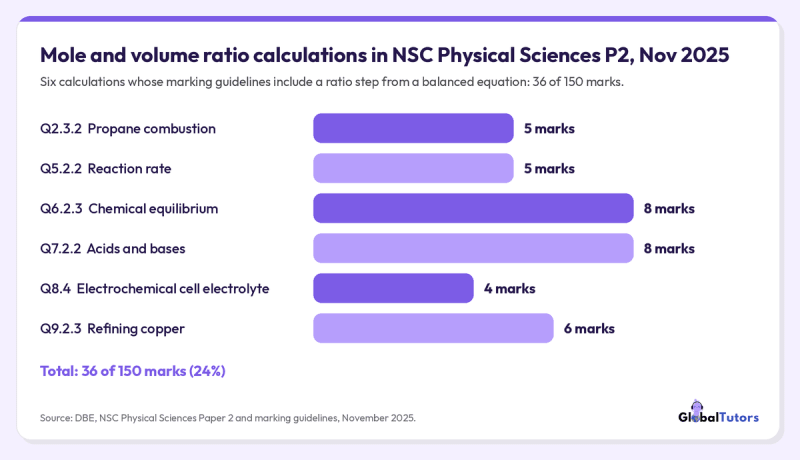 Those six calculations sat inside questions on the combustion of propane, reaction rates, chemical equilibrium, acids and bases, an electrochemical cell and the electrolytic refining of copper. Practise moles inside every Chemistry topic, not only as a stand-alone chapter.
The formulae on the data sheet
The Paper 2 data sheet in the Examination Guidelines gives these values and formulae, and the November 2025 paper's data sheet gave the same ones:
- Molar gas volume at STP: Vm = 22.4 dm³/mol
- Standard temperature 273 K and standard pressure 1.013 × 10⁵ Pa
- Avogadro's constant: NA = 6.02 × 10²³ per mol
- n = m/M and n = N/NA
- c = n/V or c = m/(MV)
- n = V/Vm
- caVa/cbVb = na/nb, for titrations
Relative atomic masses come from the periodic table on the data sheet. On the 2025 sheet, for example, H is 1, C is 12, O is 16, Mg is 24, Cl is 35.5 and Ca is 40.
How stoichiometry calculations are marked
The Paper 2 marking guidelines in the Examination Guidelines set out the rules for calculations:
- "Marks will be awarded for: correct formula, correct substitution, correct answer with unit."
- If no formula is given but all substitutions are correct, the candidate forfeits one mark.
- Marks for substitutions are only given when values are substituted into formulae, not when they are listed before a calculation starts.
- Units are only required in the final answer. A correct answer with a wrong unit, or with no unit, loses the answer mark.
- Final answers are rounded to a minimum of two decimal places when the question doesn't specify.
- Positive marking applies from one subquestion to the next: if a wrong answer from one subquestion is substituted correctly in the next, the later subquestion can earn full marks.
- The error-carrying principle doesn't apply to chemical equations.
The instructions on the November 2025 paper said the same thing in short form: "Show ALL formulae and substitutions in ALL calculations." They also said to round final numerical answers to a minimum of two decimal places.
Here is how the 2025 marking guidelines split one four-mark calculation, Question 8.4. Candidates had to find the mass of Al₂(SO₄)₃ needed to make 250 cm³ of a solution for a cell under standard conditions. The four marks were for calculating n(Al³⁺), using the mole ratio 1:2, multiplying by M = 342, and the final answer of 42.75 g. Each step earned its own mark, so write each one down.
Four worked examples
These examples are our own. Each one uses relative atomic masses from the data sheet, and numerical answers are rounded to two decimal places.
Worked example 1: percentage purity
A 2.50 g sample of crushed seashells reacts with excess hydrochloric acid. 0.448 dm³ of CO₂ is collected at STP. Calculate the percentage purity of CaCO₃.
CaCO₃ + 2HCl → CaCl₂ + H₂O + CO₂
n(CO₂) = V/Vm = 0.448/22.4 = 0.02 mol
n(CaCO₃) = n(CO₂) = 0.02 mol (ratio 1:1)
m(CaCO₃) = nM = 0.02 × 100 = 2.00 g
Purity = 2.00/2.50 × 100 = 80.00%
Worked example 2: limiting reagent
2.4 g of magnesium is added to 100 cm³ of hydrochloric acid with a concentration of 1.0 mol/dm³. Calculate the volume of hydrogen formed at STP.
Mg + 2HCl → MgCl₂ + H₂
n(Mg) = m/M = 2.4/24 = 0.1 mol
n(HCl) = cV = 1.0 × 0.1 = 0.1 mol (convert 100 cm³ to 0.1 dm³ first)
0.1 mol Mg needs 0.2 mol HCl, so HCl is the limiting reagent.
n(H₂) = n(HCl)/2 = 0.05 mol (ratio HCl:H₂ = 2:1)
V(H₂) = nVm = 0.05 × 22.4 = 1.12 dm³
Worked example 3: percentage yield
In the same reaction, 1.00 dm³ of hydrogen is actually collected at STP. Calculate the percentage yield.
Percentage yield = actual/theoretical × 100 = 1.00/1.12 × 100 = 89.29%
Worked example 4: empirical and molecular formula
A hydrocarbon is 85.7% carbon and 14.3% hydrogen by mass. Its molar mass is 56 g/mol. Find its molecular formula.
In 100 g: n(C) = 85.7/12 = 7.14 mol and n(H) = 14.3/1 = 14.3 mol
Ratio C:H = 7.14:14.3 = 1:2, so the empirical formula is CH₂ (M = 14 g/mol)
56/14 = 4, so the molecular formula is C₄H₈
A revision plan before 2 November
- Learn the seven skills in the list above. Tick each one off when you can do it without notes.
- Write the formula first, every time. Then substitute, then the answer with its unit.
- Convert cm³ to dm³ before using c = n/V. Divide by 1 000.
- Find the limiting reagent before you use any ratio. Compare what you have with what the balanced equation needs.
- Write the 2025 Paper 2 under exam conditions. The DBE publishes the paper and its marking guidelines on its website. Mark your own script step by step with the official guidelines.
- Practise with the data sheet in front of you. Use it for formulae and relative atomic masses so you know where everything is.
Our Physical Sciences past papers page links to official papers, and the matric exam timetable lists the 2026 dates. Our guide to how matric papers are marked explains marking centres, standardisation and re-marks.
FAQ
Is Grade 11 stoichiometry examined in matric?
Yes. CAPS lists stoichiometry (Grade 11) among the Grade 10 and 11 topics that are also examinable in the Grade 12 final exam.
Which paper is stoichiometry in?
Paper 2 (Chemistry). In 2026 it is on Monday 2 November at 09:00 and lasts three hours.
Do I need to memorise 22.4 dm³?
The molar gas volume at STP, 22.4 dm³/mol, is on the Paper 2 data sheet, along with n = m/M, c = n/V and n = V/Vm.
What happens if I get the first part wrong?
The DBE applies positive marking from one subquestion to the next. If you substitute your earlier answer correctly, the later subquestion can still earn full marks.
Do units matter?
Yes. Units are only needed in the final answer, but a correct answer with a wrong unit or no unit loses the answer mark.
Get help before Paper 2
Global Tutors works with South African families at home and abroad. Of our 124 tutors, 16 have examiner, marker or moderator experience, and 51% hold a teaching qualification. Ask for a tutor with examiner, marker or moderator experience. We match you with a tutor within a day, starting with a free Meet & Greet, and there are no ongoing contracts.
Find a CAPS Physical Sciences tutor | Matric tutoring | All CAPS tutoring
Sources
- DBE, October/November 2026 NSC examinations timetable: https://www.education.gov.za/Portals/0/Documents/Publications/2026/2026 Nov NSC Timetable.pdf
- DBE, Physical Sciences Examination Guidelines, Grade 12 (2021): https://www.education.gov.za/Portals/0/CD/2021 Exam Guidelines/Physical Sciences GR 12 Exam Guidelines 2021 Eng.pdf?ver=2021-05-17-160028-107
- DBE, CAPS Physical Sciences FET Phase (Grades 10 to 12): https://www.education.gov.za/Portals/0/CD/National Curriculum Statements and Vocational/CAPS FET PHYSICAL SCIENCE WEB.pdf
- DBE, 2025 November NSC exam papers (Physical Sciences Paper 2 and marking guidelines): https://www.education.gov.za/Curriculum/NationalSeniorCertificate(NSC)Examinations/2025NovemberExamPapers.aspx
Ready to excel in your exams?
Get personalized support from our expert tutors and achieve your academic goals.