IB Digital Society: the papers, the inquiry project and the marks
Global TutorsOctober 28, 2026
Digital society is an IB Diploma Programme course in the individuals and societies group, first assessed in 2024. Students study how digital systems affect people and communities, using a set of concepts, content areas and contexts. SL students sit two exam papers and complete an inquiry project. HL students sit a third paper as well. This guide sets out the course, how each paper works, and what the IB's own specimen markschemes ask for.
What IB Digital Society covers
The IB describes digital society as an interdisciplinary course for students interested in the impact and importance of digital systems and technologies. The recommended teaching time is 150 hours at SL and 240 hours at HL.
The course integrates three strands through inquiry:
- Concepts: change, expression, identity, power, space, systems, and values and ethics.
- Content: data, algorithms, computers, networks and the internet, media, artificial intelligence, and robots and autonomous technologies.
- Contexts: cultural, economic, environmental, health, human knowledge, political and social.
HL students also study an extension on challenges and interventions, with three topics: global well-being, governance and human rights, and sustainable development.
How IB Digital Society is assessed
The assessment differs between SL and HL. Here is the split from the IB subject brief:
- SL Paper 1: 1 hour 30 minutes, 40% of the final grade.
- SL Paper 2: 1 hour 15 minutes, 30%.
- SL inquiry project (internal): 30 hours, 30%.
- HL Paper 1: 2 hours 15 minutes, 35%.
- HL Paper 2: 1 hour 15 minutes, 20%.
- HL Paper 3: 1 hour 15 minutes, 25%.
- HL inquiry project (internal): 30 hours, 20%.
That gives 2 hours 45 minutes of exams at SL (70% of the grade) and 4 hours 45 minutes at HL (80%). The chart below shows the weightings side by side.
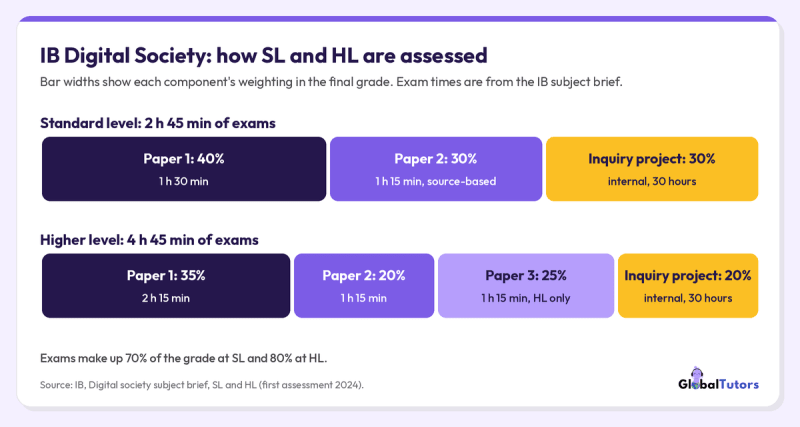
Paper 2 is the same length at both levels, but it carries 30% at SL and 20% at HL, because HL adds Paper 3.
Paper 1: questions on the syllabus and real-world examples
The subject brief describes Paper 1 as questions that address the syllabus and real-world examples in an integrated way. At HL, students also address challenges and interventions.
In the IB's specimen papers (for first examinations in 2024):
- SL Paper 1: answer two questions, each worth 20 marks, for a maximum of 40 marks.
- HL Paper 1: Section A, answer two questions worth 20 marks each. Section B, answer one question worth 12 marks. The maximum is 52 marks.
Each specimen Section A question has parts (a), (b) and (c) adding up to 20 marks, and part (c), an extended response, is worth 8 marks. The part (c) questions use command terms such as "to what extent", "discuss" and "evaluate", and some ask students to refer to one course concept.
Paper 2: the source-based paper
Paper 2 has source-based questions that address the syllabus in an integrated way. The specimen Paper 2 comes with a source booklet of four sources, and students answer all four questions, worth 2, 4, 6 and 12 marks, for a maximum of 24 marks.
The specimen markscheme for the 12-mark question is clear on one point: if a response uses only the source material, or only the student's own knowledge, it can be awarded a maximum of 8 marks. To reach 12, the markscheme expects argument and a synthesis of all four sources with the student's own knowledge.
Paper 3: the HL intervention paper
HL Paper 3 has questions about an intervention related to an HL extension challenge outlined in a pre-released statement. In the specimen, students need a clean copy of the pre-released statement in the exam, read a source booklet, and answer all questions for a maximum of 30 marks. The specimen questions are worth 2, 2, 6, 8 and 12 marks, and the 8-mark question asks students to evaluate an app in terms of equity and acceptability.
The inquiry project
The internal assessment is an inquiry project into the impacts and implications of a chosen digital system for people and communities. The requirements are the same at SL and HL. The project is submitted with three items:
- an inquiry process document
- a recorded multimedia presentation
- a list of references.
What the specimen markschemes ask for
The IB's specimen markschemes give useful guidance on how answers are judged:
- Command terms matter. The markscheme explains each command term as it is used. "Identify" needs an answer from a number of possibilities without further detail, while "explain" needs a detailed account with reasons or causes.
- Lists are not closed. The markschemes list likely points but say they are not exhaustive, and examiners should credit other valid points.
- Top bands need evaluation. For Paper 1 part (c), the 7 to 8 mark band describes sustained evaluation and synthesis supported with relevant and accurate knowledge, in a well-structured response.
- Counter-claims count at HL. The HL Paper 1 Section B markbands refer to counter-claims in every band above zero, and the top band needs them to be effectively addressed.
How to prepare for IB Digital Society
- Build a bank of real-world examples. Paper 1 and Paper 2 both ask for real-world examples, so collect several for each content area and context.
- Link examples to concepts. Practise explaining one example through two or three concepts, such as power or values and ethics.
- Practise synthesis in Paper 2. In the 12-mark question, use every source and add your own knowledge in the same answer.
- Learn the command terms. Match the length and depth of each answer to the command term and the marks.
- Plan the inquiry project early. Leave time for the inquiry process document and the recorded presentation, not only the research.
- Use official material. The IB publishes the digital society specimen papers and markschemes on its sample exam papers page.
For more on how the Diploma Programme fits together, read our IB Diploma Programme guide. Our guide on where to find IB resources and past papers covers official materials, and the IB hub covers the wider programme.
FAQ
Which subject group is IB Digital Society in?
Individuals and societies. The IB describes it as an interdisciplinary course.
How many exam papers are there in IB Digital Society?
Two at SL (Papers 1 and 2) and three at HL (Papers 1, 2 and 3).
What is the IB Digital Society internal assessment?
An inquiry project into the impacts and implications of a chosen digital system for people and communities. It is worth 30% at SL and 20% at HL.
What does the HL extension cover?
Challenges and interventions in three areas: global well-being, governance and human rights, and sustainable development.
When was IB Digital Society first assessed?
In 2024.
Get help with IB Digital Society
Global Tutors works with South African families at home and abroad, including IB students. Of our 124 tutors, 16 have examiner, marker or moderator experience, and 51% hold a teaching qualification. Ask for a tutor with examiner, marker or moderator experience. We match you with a tutor within a day, starting with a free Meet & Greet, and there are no ongoing contracts.
Find an IB Diploma tutor | IB internal assessment help
Sources
- IB, Digital society in the DP: https://www.ibo.org/programmes/diploma-programme/curriculum/individuals-and-societies/digital-society/
- IB, Digital society subject brief, SL and HL (first assessment 2024): https://ibo.org/globalassets/new-structure/recognition/pdfs/digital-society-subject-brief-en.pdf
- IB, Digital society specimen papers 1, 2 and 3 with markschemes (first examinations 2024): https://ibo.org/globalassets/new-structure/programmes/dp/pdfs/digital-society-hl-sl-specimen-papers-1-2-3-en.pdf
- IB, DP curriculum (subject groups): https://www.ibo.org/programmes/diploma-programme/curriculum/
- IB, Diploma sample exam papers: https://www.ibo.org/programmes/diploma-programme/assessment-and-exams/sample-exam-papers/
Ready to excel in your exams?
Get personalized support from our expert tutors and achieve your academic goals.