IB in South Africa: schools, exemption and university entry
Global TutorsOctober 29, 2026
South African families who choose the International Baccalaureate (IB) Diploma Programme need to know two things early: whether the diploma opens the door to South African universities, and what those universities ask for. The short answer is that an IB Diploma with at least 24 points meets the Matriculation Board's exemption requirement, and universities then set their own subject and grade requirements on top. This guide sets out the official rules, using Universities South Africa (USAf), the IB and the University of Cape Town (UCT) 2027 prospectus.
The IB in South Africa: schools and programmes
The IB's country page for South Africa lists 12 IB World Schools, and says there has been an IB World School in the country since 1994. IB World Schools are independent from the IB and set their own admissions policies, so subject choices vary from school to school.
The Diploma Programme is a two-year programme for students aged 16 to 19. Students take six subjects, normally three (and not more than four) at higher level (HL) and the rest at standard level (SL), plus the core: the extended essay, theory of knowledge, and creativity, activity, service (CAS). The diploma is awarded to students who score at least 24 of the 45 available points and meet the other conditions. Students who don't take, or don't earn, the full diploma receive Diploma Programme course results, a grade from 1 to 7 for each course.
Why exemption matters
The Matriculation Board, an advisory body to USAf, states that candidates who did not follow the formal secondary school route in the South African schooling system need to qualify for a certificate of complete or conditional exemption from the matriculation endorsement requirements. Its online application page adds that exemption for degree studies is needed for applicants who intend to register at a South African university or an affiliated private higher education institution. UCT's 2027 prospectus states that applicants with non-South African secondary school leaving certificates must have met the requirements for matriculation exemption.
The Matriculation Board's IB page lists these routes:
- The IB Diploma, with at least 24 points.
- The IB Certificate route: two Higher Level pass marks plus three Standard Level pass marks, provided English has been passed. The Board gives the pass mark as 4 to 7. (The IB now calls these individual subject results Diploma Programme course results, formerly a certificate of results.)
The same page states that the IB's revised Mathematics at Higher and Standard level can be considered equivalent to NSC Mathematics, and may be considered for admission and exemption on the same basis.
How to apply for exemption
Applications go through the Matriculation Board's online assessment and application portal. The Board's own notes set out the practical points:
- The fee. A non-refundable exemption fee is payable upfront. The fee for 2026 is R1,070.
- Provisional and final documents. The Board can issue a provisional letter based on scanned, emailed or faxed copies. For the final certificate, correctly certified copies of the documents must be posted or couriered to the Board.
- Check eligibility first. The Board repeats that the exemption fee is non-refundable, so check the requirements and documents before paying.
What UCT asks of IB applicants in 2027
Exemption makes an applicant eligible to be considered. It doesn't guarantee a place. Each university and faculty sets its own requirements, and UCT's 2027 undergraduate prospectus shows how one university uses IB results.
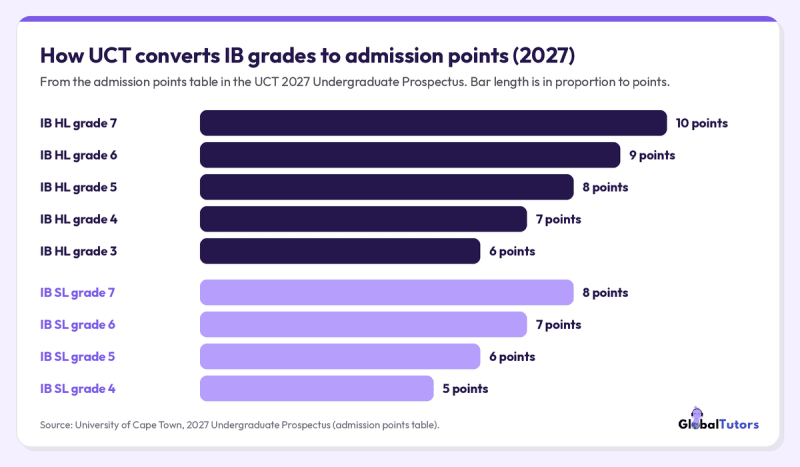
UCT converts IB grades to points with an admission points table:
- IB Higher Level: 7 = 10 points, 6 = 9, 5 = 8, 4 = 7, 3 = 6.
- IB Standard Level: 7 = 8 points, 6 = 7, 5 = 6, 4 = 5.
The chart below shows the same table.
Some faculties use points and some use subject minimums. Examples from the 2027 prospectus:
- Commerce: IB Diploma applicants must hold the diploma (not the certificate) with at least 3 HL and 3 SL subjects. For BCom and BBusSc streams other than Actuarial Science and Quantitative Finance, Mathematics needs at least Grade 5 at HL or Grade 6 at SL, and English at least Grade 3 at HL or Grade 5 at SL. Mathematical Studies and Maths Main are not accepted.
- Engineering (for example Chemical, Civil, Mechanical, and Mechanical and Mechatronic Engineering): a full IB Diploma with a Grade 6 at SL or a Grade 5 at HL in each of Mathematics, Physics and Chemistry. Mathematical Studies is not acceptable.
- MBChB (medicine): a minimum admission score of 40 points, with 46 points or above listed as the likely admission score, plus a National Benchmark Test (NBT) score in the Proficient range. It needs at least Grade 5 in three HL subjects, two of which must be Mathematics and/or Chemistry and/or Physics and/or English, and Grade 5 in the remaining two of those subjects, which may be at SL. IB applicants must hold the IB Diploma, not the certificate.
UCT also states that most undergraduate applicants who normally reside, or have completed or are completing schooling, in South Africa must write the NBTs. The prospectus notes that meeting minimum requirements does not guarantee admission.
Planning IB subject choices for a South African degree
- Start from the degree. Look up the faculty requirements for the degrees your child is considering before IB subjects are chosen, as maths and science courses at HL or SL can decide eligibility.
- Check the maths course. UCT's Commerce and Engineering requirements name the grade needed in Mathematics at HL or SL. Read the exact requirement for each programme.
- Aim above the minimum. UCT gives both a minimum and a likely admission score for MBChB, so plan towards the higher figure.
- Keep English in view. Exemption through IB course results depends on passing English, and UCT sets English grades for some programmes.
- Book the NBTs in time if your child lives or is at school in South Africa.
- Apply for exemption early. The Board can issue a provisional letter on scanned copies while the certified copies are on their way.
For how the IB compares with the local system, read our IEB vs NSC (CAPS) guide. Families weighing Cambridge instead can read Cambridge AS and A Levels in South Africa, and our IB Diploma Programme guide covers the programme itself. The IB hub has more.
FAQ
Is the IB Diploma recognised by South African universities?
Yes, through exemption. The Matriculation Board lists the IB Diploma with at least 24 points as meeting its requirements. Universities then apply their own programme requirements.
Can IB course results without the full diploma give exemption?
The Matriculation Board's IB Certificate route lists two Higher Level and three Standard Level pass marks, provided English has been passed, with a pass mark of 4 to 7. Some UCT programmes, such as MBChB, require the full IB Diploma.
How much does a Matriculation Board exemption cost?
The non-refundable fee for 2026 is R1,070.
How many IB schools are there in South Africa?
The IB's country page lists 12 IB World Schools in South Africa.
Do IB students in South Africa write the NBTs?
UCT states that most undergraduate applicants who normally reside, or are at school, in South Africa must write the NBTs.
Get help with the IB in South Africa
Global Tutors works with South African families at home and abroad, including IB Diploma students. Of our 124 tutors, 16 have examiner, marker or moderator experience, and 51% hold a teaching qualification. Ask for a tutor with examiner, marker or moderator experience. We match you with a tutor within a day, starting with a free Meet & Greet, and there are no ongoing contracts.
Find an IB Diploma tutor | IB internal assessment help
Sources
- Universities South Africa, Matriculation Board, International Baccalaureate: https://mb.usaf.ac.za/international-baccalaureate/
- Universities South Africa, Matriculation Board (exemption fees for 2026 and documents): https://mb.usaf.ac.za/
- Universities South Africa, Matriculation Board, Online assessment and application: https://mb.usaf.ac.za/online-assessment-and-application/
- Universities South Africa, Matriculation Board, Admission of foreign school leavers: https://mb.usaf.ac.za/admission-of-foreign-school-leavers/
- Universities South Africa, Matriculation Board, Exemption requirements: https://mb.usaf.ac.za/exemption-requirements/
- IB, South Africa country page: https://www.ibo.org/country/ZA/
- IB, DP assessment FAQ (diploma award and course results): https://ibo.org/programmes/diploma-programme/assessment-and-exams/getting-results/assessment-faq/
- IB, Physics subject brief (Diploma Programme overview: six subjects, HL and SL, the core): https://ibo.org/globalassets/new-structure/recognition/pdfs/dp_sciences_physics_subject-brief_jan_2022_e.pdf
- University of Cape Town, 2027 Undergraduate Prospectus: https://uct.ac.za/sites/default/files/media/documents/2027-uct-undergraduate-prospectus-1-april-2026.pdf
Ready to excel in your exams?
Get personalized support from our expert tutors and achieve your academic goals.