IB Physics papers: the data-based questions and Paper 2
Global TutorsOctober 29, 2026
IB Diploma Programme physics, first assessed in 2025, has two exam papers and one piece of internal assessment at both levels. Paper 1 is taken in one sitting but has two parts: Paper 1A (multiple choice) and Paper 1B (data-based questions). Paper 2 has short-answer and extended-response questions. This guide sets out how each paper works, using the IB subject brief and the IB's own specimen papers and markschemes, and how to prepare for them.
How IB Physics is assessed
The IB physics subject brief (first assessment 2025) gives this assessment model:
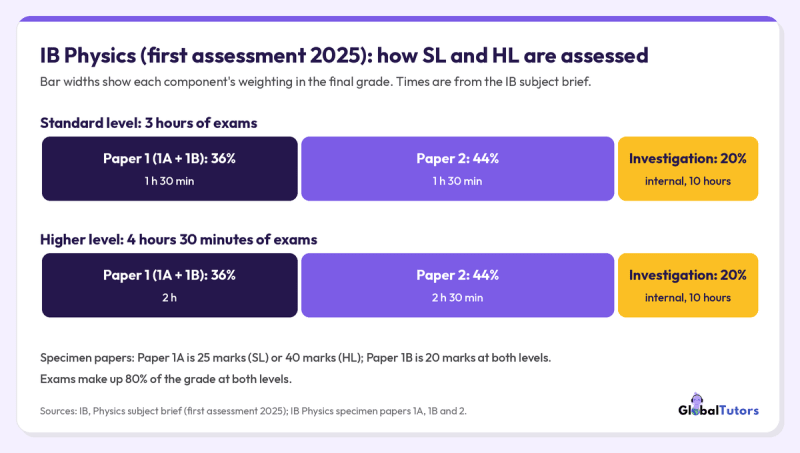
- Paper 1 (Paper 1A multiple choice plus Paper 1B data-based questions): 1.5 hours at SL and 2 hours at HL, 36% of the final grade.
- Paper 2 (short-answer and extended-response questions): 1.5 hours at SL and 2.5 hours at HL, 44%.
- Scientific investigation (internal): 10 hours at both levels, 20%.
That makes the exams 80% of the grade, with 3 hours of exams at SL and 4.5 hours at HL. The weightings are the same at SL and HL; HL students have more time and more content. The chart below shows the split.
The recommended teaching time is 150 hours at SL and 240 hours at HL. The syllabus content is grouped into five themes: A Space, time and motion; B The particulate nature of matter; C Wave behaviour; D Fields; and E Nuclear and quantum physics. Each theme is explored through three concepts that run through the course: forces, energy and particles.
Paper 1A: the multiple-choice section
In the IB specimen papers (for first examinations in 2025), Paper 1A is worth 25 marks at SL and 40 marks at HL. The instructions say to answer all questions, choosing the best answer for each one. A calculator is required, and so is a clean copy of the physics data booklet.
Because Paper 1A and Paper 1B share one sitting, the time is shared too. The specimen front covers give 1 hour 30 minutes for both parts at SL (45 marks in total) and 2 hours at HL (60 marks in total). Both work out at 2 minutes per mark, so plan your time across the two parts before the exam rather than during it.
Paper 1B: the data-based questions
Paper 1B is worth 20 marks at both SL and HL in the specimen papers. Students answer all questions in the answer boxes provided, again with a calculator and the data booklet.
The specimen Paper 1B questions are built around student experiments. The skills they test include:
- Combining uncertainties. One part gives two identical power supplies in series, each known to within 0.01 kV, and asks for the uncertainty in the total. The markscheme answer is 0.02 kV.
- Reducing an uncertainty. A stopwatch reads to the nearest 0.1 s. The markscheme credits timing many bounces and dividing by the number of bounces.
- Judging a relationship from a graph. The markscheme credits the point that a straight line can't be drawn through all the error bars, so the relationship is unlikely to be linear.
- Linearising data. Students test a proposed relationship by plotting T against 1/V, draw a line of best fit and find the gradient. The markscheme accepts an answer in a range (3.8 to 4.2) and expects a large triangle or two points far apart on the line.
- Handling repeated readings. Six readings of a deflection are given, including one that the markscheme treats as an outlier. The markscheme credits saying that 3 significant figures is inappropriate for one group's mean and that the other group rejected the outlier.
- Percentage uncertainty. A ruler's cross-section is a = (28 ± 1) mm by b = (3.00 ± 0.05) mm. Adding the fractional uncertainties, 1/28 + 0.05/3.00 = 0.0357 + 0.0167 = 0.052, gives the 5% in the markscheme.
These are the skills to practise for Paper 1B: uncertainties, graphs, linearisation and gradients, and comments on data quality.
How IB Physics Paper 2 works
The subject brief describes Paper 2 as short-answer and extended-response questions. In the specimen HL Paper 2 (2 hours 30 minutes), students answer all questions in the answer boxes, with a calculator and the data booklet, for a maximum of 90 marks. That is 1 minute 40 seconds per mark.
The specimen questions range across the themes. Examples include a block-and-friction problem, relativity calculations, a standing-wave question about microwave ovens, a satellite orbit, induction in conducting rings, a smoke detector using americium-241, the black-body spectrum of a star, a mixing experiment with paraffin and an oil-drop question. The final HL question links sea waves, coal, nuclear fission and nuclear fusion, and ends by asking students to discuss the four methods with reference to efficiency, environmental impact and availability of resources.
One part of the oil-drop question shows the style of calculation expected. Plates 8.0 mm apart with a potential difference of 960 V give a field strength of E = V/d = 960 / 0.0080 = 1.2 x 10^5 N C^-1, the answer in the markscheme.
What the specimen markschemes credit
The general marking notes printed with the specimen markschemes include these points:
- Follow-through marks. If an error is made in an early part and the wrong answer is used correctly later, follow-through marks are awarded (marked ECF, error carried forward). Keep going on a multi-part question even if you are unsure of an earlier answer.
- Units and significant figures. Examiners are told not to penalise errors in units or significant figures unless the notes column says so. Show both anyway, because some parts do specify them; one oil-drop part requires the answer to 3 or more significant figures.
- Essential words. Underlined words in the markscheme are essential for the mark, so learn the precise terms.
- Equivalent answers. An answer with the same meaning as the markscheme answer earns the mark, and effective communication counts for more than grammatical accuracy.
How to prepare for IB Physics Papers 1 and 2
- Use the data booklet in every practice session. A clean copy is required in both papers, so get to know where each equation sits.
- Practise uncertainties until they are routine. Absolute, fractional and percentage uncertainties, and error bars, all appear in the specimen Paper 1B.
- Draw graphs by hand. Practise lines of best fit and gradients using a large triangle.
- Work through the specimen papers under timed conditions. Use 2 minutes per mark for Paper 1 and check your pace on Paper 2.
- Write out every step in Paper 2. Show the equation, the substitution and the answer with a unit, so method and follow-through marks are available.
- Prepare for the discussion questions. Practise writing short comparisons that use the data given in the question.
The scientific investigation is the other 20%. It is an open-ended task in which the student gathers and analyses data to answer their own research question, written up as a report of up to 3,000 words. For help with it, see our IB internal assessment tutoring.
For more on how physics fits into the wider programme, read our IB Diploma Programme guide. Our guide on where to find IB resources and past papers covers official practice material, and the IB hub covers the wider programme.
FAQ
What is IB Physics Paper 1B?
The data-based part of Paper 1. It is taken in the same sitting as the Paper 1A multiple-choice questions, and in the specimen papers it is worth 20 marks at both SL and HL.
How long is IB Physics Paper 2?
1.5 hours at SL and 2.5 hours at HL. It is worth 44% of the final grade at both levels.
Is a calculator allowed in IB Physics?
Yes. The specimen papers say a calculator is required for Paper 1A, Paper 1B and Paper 2, along with a clean copy of the physics data booklet.
How much is the IB Physics internal assessment worth?
20%. The scientific investigation is written up as a report with a maximum of 3,000 words.
When was the current IB Physics course first assessed?
In 2025.
Get help with IB Physics
Global Tutors works with South African families at home and abroad, including IB students. Of our 124 tutors, 16 have examiner, marker or moderator experience, and 51% hold a teaching qualification. Ask for a tutor with examiner, marker or moderator experience. We match you with a tutor within a day, starting with a free Meet & Greet, and there are no ongoing contracts.
Find an IB Physics tutor | IB Diploma tutoring
Sources
- IB, Physics in the DP: https://www.ibo.org/programmes/diploma-programme/curriculum/sciences/physics/
- IB, Physics subject brief, SL and HL (first assessment 2025): https://ibo.org/globalassets/new-structure/recognition/pdfs/dp_sciences_physics_subject-brief_jan_2022_e.pdf
- IB, Physics specimen papers 1A, 1B and 2 with markschemes, HL and SL (first examinations 2025): https://ibo.org/globalassets/new-structure/programmes/dp/pdfs/physics-hl-sl-specimen-papers-1a-2b-2-en.pdf
Ready to excel in your exams?
Get personalized support from our expert tutors and achieve your academic goals.