IEB English Home Language Paper 2: how to answer the essay questions
Global TutorsOctober 15, 2026
IEB English Home Language Paper 2 for 2026 is on Thursday 19 November, from 09:00 to 12:00, a week after Paper 1 on Thursday 12 November. In 2025, Paper 2 was the literature and transactional writing paper, with 60 of its 100 marks for the literature essays, and the IEB's own marking guidelines say clearly what earns them. This guide sets out how the November 2025 paper worked, what the rubric rewards and how to use the three hours.
How IEB English Paper 2 is structured
The November 2025 paper was 3 hours and 100 marks, in two sections.
Section A: Literature (60 marks)
- Question 1, Shakespeare (compulsory, 30 marks). In 2025 this was a literary essay on Othello in response to a quotation, referring to at least two characters.
- One novel essay (30 marks). Learners chose one of two questions on their novel. In 2025 the novels were Brave New World and The White Tiger.
- Length. Each essay should be approximately 600 words.
Section B: Transactional writing (40 marks)
- Question 6 (compulsory, 20 marks). In 2025 this was an open letter.
- Question 7 or Question 8 (20 marks).
- Length and format. The body of each piece should be approximately 250 to 300 words, and "It is essential that the appropriate format is used."
Three other instructions matter. No word count is required for any question. Each question begins on a new page of the answer book. And the paper says: "You are encouraged to give your own judgements."
What the essay rubric rewards
The literature essays are marked out of 30 against a level rubric that assesses knowledge, argument, thinking and structure. The 2025 marking guidelines add some important notes:
- It isn't a tick-box. "The rubric is not a check-list (tick-box) but should be considered as a guide when evaluating the Literary Essay."
- Length is a guide. About 600 words is a suggested length, and "There is no penalty for length other than the development of the argument in the essay itself."
- Planning earns nothing directly. A mind map may be used for planning, but no marks are awarded for planning.
- Half marks may be awarded.
The top levels describe an essay with "strong individual voice", "consistent question focus" and quotations that "enhance a tightly constructed argument". In plain terms, the rubric describes a clear stance that answers the exact topic, backed by well-chosen evidence from the text.
The transactional pieces are marked out of 20: 10 for purpose, audience and content and 10 for language and register. The two marks are separate, so strong ideas can't make up for the wrong register, and the reverse is also true.
How to answer an essay question in five steps
- Unpack the topic. Underline the key terms and the instruction word, such as "critically discuss" or "to what extent". The 2025 Shakespeare topic asked "to what extent", which invites a weighed judgement rather than a yes or no.
- Take a stance in one sentence. Write it at the top of your plan. Every paragraph must support it.
- Plan four or five body paragraphs. Each one makes one point, backed by a short quotation or close reference, and links back to the topic.
- Write with the topic's words. Use the key terms in your introduction, in your topic sentences and in your conclusion. This keeps the question focus the rubric looks for.
- Conclude with your judgement. Don't just summarise. Say what your argument shows about the text.
A three-hour plan
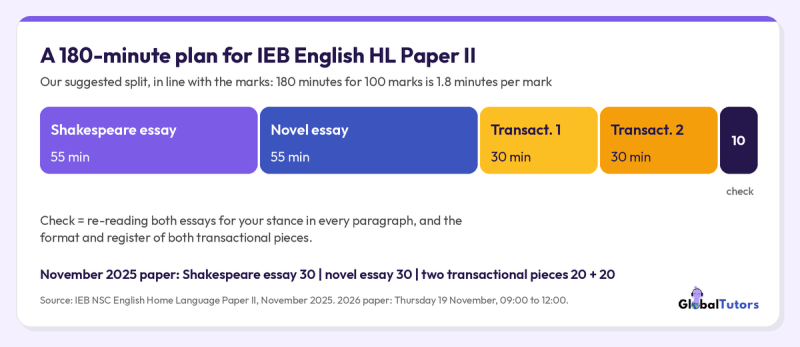
180 minutes for 100 marks gives 1.8 minutes per mark. Our suggested split:
- Shakespeare essay (30 marks): 55 minutes
- Novel essay (30 marks): 55 minutes
- First transactional piece (20 marks): 30 minutes
- Second transactional piece (20 marks): 30 minutes
- Checking: 10 minutes
That adds up to 180 minutes. Your child can also write the transactional pieces first: the paper allows questions to be answered in any order, as long as they are numbered correctly.
Habits that work against the rubric
Avoid these:
- Retelling the plot. Summary isn't argument. Each paragraph should make a point about the topic, not describe what happens next.
- Answering a prepared question. A memorised essay may not fit the exact topic, and question focus is part of the rubric.
- Quotations without comment. A quotation should be followed by what it shows and how it supports the stance.
- Losing the stance halfway. Re-read your stance before every new paragraph.
- Wrong format or register in Section B. An open letter, a speech and a review each have their own conventions. The paper states that the appropriate format is essential.
How to prepare in the last month
- Know the texts closely. Build a bank of short quotations for each major character and theme, and learn them.
- Write to time. Write at least one essay on each text in 55 minutes, using a past topic, then compare it with the rubric.
- Practise stances. Take five past topics and write a one-sentence stance and paragraph plan for each in five minutes.
- Use the IEB's own papers. The IEB offers papers and marking guidelines from the previous five years. It also notes that its marking guidelines "do not reflect the full range of acceptable and partially acceptable answers that applied during the marking session".
- Practise the formats. Write one example each of the common transactional formats your child has studied.
Our IEB English past papers guide explains where to find papers and how to use them.
FAQ
When is IEB English Paper 2 in 2026?
Thursday 19 November 2026, from 09:00 to 12:00. Paper 1 is on Thursday 12 November.
How long should a Paper 2 literature essay be?
The 2025 paper asked for approximately 600 words. The marking guidelines describe this as a suggested length and say the development of the argument takes precedence.
Do I need to write a word count?
No. The 2025 paper stated that no word count is required for any question.
Are marks given for planning?
No. A mind map may be used to plan, but the 2025 marking guidelines state that no marks are awarded for planning.
How are the transactional pieces marked?
Out of 20: 10 for purpose, audience and content, and 10 for language and register.
Get an IEB English tutor
A tutor can mark timed essays against the rubric and show your child exactly where their argument loses focus. Of our 124 tutors, 51% hold a teaching qualification and 16 have examiner, marker or moderator experience, two of them with the IEB. We match you with a tutor within a day, starting with a free, no-obligation Meet & Greet. There are no ongoing contracts.
Find an IEB English tutor | IEB English tutoring | Study strategies for South African students
Sources
- IEB, NSC English Home Language Paper II, November 2025, and its marking guidelines (from the IEB past papers page): https://www.ieb.co.za/assessment/high-schools/national-senior-certificate/nsc-past-papers
- IEB, 2026 NSC final examination timetable (Circular 38 of 2026): https://www.ieb.co.za/assessment/high-schools/national-senior-certificate/ieb-nsc-examination-timetables
Related IEB tutoring
IEB and Matric tutoring for South African students.
Ready to excel in your exams?
Get personalized support from our expert tutors and achieve your academic goals.