
How IEB Maths Paper 1 is marked, and how to earn the marks
Global TutorsOctober 12, 2026
IEB Maths Paper 1 for 2026 is on Monday 26 October, from 09:00 to 12:00. It is a three-hour paper, and the November 2025 paper was out of 150 marks. The paper tells your child how it will be marked: "Answers only will NOT necessarily be awarded full marks." This guide explains what that means in practice, how the marking guidelines are used, and the habits that protect marks on the day.
What IEB Maths Paper 1 looks like
The November 2025 paper is the most recent one published by the IEB:
- 3 hours, 150 marks, 13 questions.
- Two sections. Section A (Questions 1 to 6) carried 73 marks. Section B (Questions 7 to 13) carried 77 marks.
- Question size. Questions ranged from 5 to 18 marks.
- Topics. The paper covered equations and inequalities, number patterns and series, finance, functions and graphs, differential calculus (including an optimisation problem) and probability.
- Answers go on the paper. Learners answer in the spaces provided on the question paper.
- Information sheet. A two-page information sheet is provided with the paper.
- Rounding. Answers are rounded to two decimal places where necessary, unless the question says otherwise.
Paper 2 follows on Tuesday 10 November, from 09:00 to 12:00.
How IEB Maths Paper 1 is marked
Working is part of the answer
Instruction 6 on the November 2025 paper reads: "Clearly show ALL calculations, diagrams, graphs, etc. that you have used to determine your answers. Answers only will NOT necessarily be awarded full marks."
So a correct number with no working is not guaranteed full marks. A learner who writes down each step gives the marker something to credit. Write the formula, substitute, simplify, then give the answer.
Everyone marks from the same guideline
The IEB's Paper 1 marking guidelines state that they were prepared for examiners and sub-examiners, who all have to attend a standardisation meeting. That meeting makes sure every marker reads the guideline the same way.
Umalusi, the quality council that checks the IEB, reports that these meetings were held for the November 2025 papers. Senior marking staff mark sample ("dummy") scripts before marking starts, and the guidelines are finalised there.
The published memo is a guide, not the full list
The IEB publishes past papers and marking guidelines as a study aid, with this warning: "The marking guidelines are only guidelines. They do not reflect the full range of acceptable and partially acceptable answers that applied during the marking session."
When your child marks a practice paper and finds that their method differs from the memo, that doesn't mean it's wrong. A correct method that is clearly set out is the goal.
How long to spend on each question
Three hours for 150 marks works out at 1.2 minutes per mark. A 10-mark question deserves about 12 minutes, and the 18-mark Question 3 on the 2025 paper deserved about 21½ minutes.
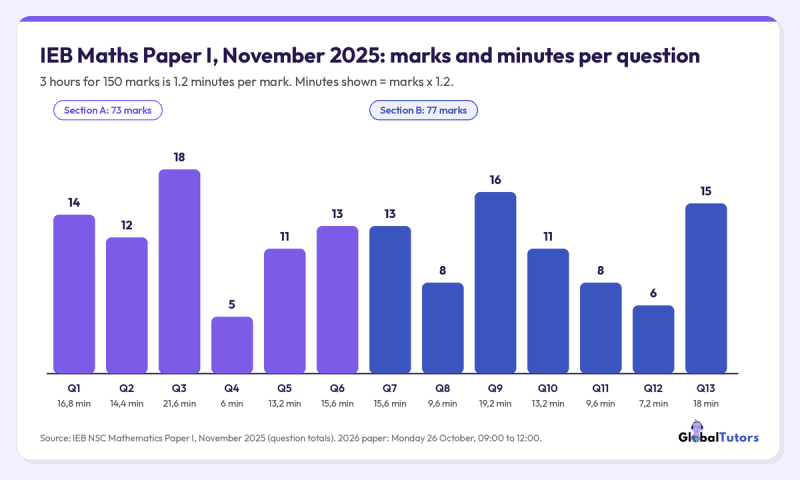
Use this as a guide while practising. If a question takes far longer than its marks suggest, move on and come back to it once the rest of the paper is done.
Five checks that protect marks
None of these is a trick. Each one is about the maths being right and visible.
1. Turning points: set f′(x) = 0, then find y.
Take f(x) = x³ − 3x² − 9x + 2.
- f′(x) = 3x² − 6x − 9 = 3(x − 3)(x + 1)
- f′(x) = 0 gives x = 3 or x = −1
- f(3) = 27 − 27 − 27 + 2 = −25 and f(−1) = −1 − 3 + 9 + 2 = 7
- The turning points are (3 ; −25) and (−1 ; 7).
Don't stop at the x-values. The question asks for points, so substitute back into f(x), not f′(x).
2. Quadratic inequalities: factorise, find critical values, then test.
For x² − x − 6 ≤ 0, factorise to (x − 3)(x + 2) ≤ 0. The critical values are −2 and 3. The expression is negative between them, so −2 ≤ x ≤ 3. When dividing both sides of an inequality by a negative number, reverse the sign: −2x > 6 gives x < −3.
3. Number patterns: Tₙ is a term, Sₙ is a sum.
For an arithmetic sequence, Tₙ = a + (n − 1)d and Sₙ = n/2 [2a + (n − 1)d]. With a = 3 and d = 4, T₁₀ = 3 + 9(4) = 39, while S₁₀ = 5[6 + 36] = 210. Read whether the question wants the 10th term or the sum of 10 terms.
4. Finance: match i and n to the compounding period.
For 12% per annum compounded monthly over 5 years, i = 0,12 ÷ 12 = 0,01 and n = 5 × 12 = 60. Then decide whether the question wants a future value (saving towards an amount) or a present value (a loan paid off by instalments), and choose the formula to match.
5. Round once, at the end.
Keep full calculator values through the working and round to two decimal places only in the final answer, unless the question says otherwise.
How to practise like a marker
- Use the IEB's own papers. The IEB offers papers and marking guidelines from the previous five years on its website. Older papers can be requested by email.
- Write under exam conditions. Do one full paper in three hours, with the information sheet and no notes.
- Mark with the memo, then rewrite. For every lost mark, write the correct solution out in full, step by step.
- Keep an error log. Note what went wrong and where: sign errors, missed working, wrong formula, rounding. Patterns show up after two or three papers.
- Target the big questions. Functions, calculus and number patterns were all on the 2025 paper. Rehearse the full method for each.
Our IEB past papers guide explains how to find and use them. Our Grade 12 Maths revision notes cover each topic.
When tutoring helps most
In the final days before Paper 1, a tutor can mark one full timed paper with your child and work on the two or three habits that cost the most marks. Between Paper 1 and Paper 2 on 10 November, the focus moves to Paper 2 topics.
Of our 124 tutors, 51% hold a teaching qualification and 16 have examiner, marker or moderator experience, two of them with the IEB. Ask for a tutor with examiner, marker or moderator experience. Our parent's guide to improving IEB Maths marks has more ideas you can use at home.
FAQ
When is IEB Maths Paper 1 in 2026?
Monday 26 October 2026, from 09:00 to 12:00. Paper 2 is on Tuesday 10 November, from 09:00 to 12:00.
How many marks is IEB Maths Paper 1?
The November 2025 paper was out of 150 marks and lasted 3 hours. The 2026 paper is also scheduled for 3 hours.
Why must my child show all working?
The paper's own instructions say that answers only will not necessarily be awarded full marks. Clear steps let the marker credit your child's method.
Can my child use a calculator?
Yes. The 2025 paper allowed an approved non-programmable, non-graphical calculator unless a question stated otherwise.
Where can we get IEB Maths past papers?
On the IEB's past papers page, which has papers and marking guidelines for the previous five years.
Get an IEB Maths tutor
We match you with a tutor within a day, starting with a free, no-obligation Meet & Greet. There are no ongoing contracts.
Find an IEB Grade 12 Maths tutor | IEB Maths tutoring | IEB maths past papers
Sources
- IEB, NSC Mathematics Paper I, November 2025, and its marking guidelines (from the IEB past papers page): https://www.ieb.co.za/assessment/high-schools/national-senior-certificate/nsc-past-papers
- IEB, 2026 NSC final examination timetable (Circular 38 of 2026): https://www.ieb.co.za/assessment/high-schools/national-senior-certificate/ieb-nsc-examination-timetables
- Umalusi, Report on the quality assurance of the IEB November 2025 NSC examinations and assessment: https://www.umalusi.org.za/wp-content/uploads/2026/03/REPORT-ON-THE-QA-OF-THE-IEB-NOVEMBER-2025-EXAMINATIONS-1.pdf
Related IEB tutoring
IEB and Matric tutoring for South African students.
Ready to excel in your exams?
Get personalized support from our expert tutors and achieve your academic goals.