IGCSE English First Language 0500: directed writing explained
Global TutorsOctober 26, 2026
Directed writing is Section A of Cambridge IGCSE First Language English (0500) Paper 2. You read one or two texts and use their ideas to write a speech, letter, article or report for a given audience. The task is worth 40 of the paper's 80 marks, and its format changes for exams from 2027. This guide covers how the task works under the 2027 to 2029 syllabus, what changed from the 2024 to 2026 version, and how to prepare.
Where directed writing sits in 0500
Under the 0500 syllabus for 2027, 2028 and 2029, every candidate takes two components:
- Paper 1, Reading: 2 hours, 80 marks, 50% of the qualification
- Either Paper 2, Directed Writing and Composition: 2 hours, 80 marks, 50%
- Or Component 3, Coursework Portfolio: three extended writing assignments, 80 marks, 50%
Component 4, the Speaking and Listening Test, is optional and separately endorsed, so its marks don't count towards the overall grade. Exams run in the June and November series.
So directed writing is examined in Paper 2. Learners on the coursework route write a directed writing piece as Assignment 1 instead, in response to one or two texts chosen by the teacher.
How IGCSE 0500 directed writing works from 2027
Paper 2 has two sections, and you answer one question from each. The texts are printed on an insert, and dictionaries may not be used.
Section A, Directed Writing (40 marks). One question in two parts, based on one or two texts totalling 550 to 650 words.
- Question 1(a), 5 marks. A structured question that asks you to analyse, evaluate and show your understanding of the text or texts. It tests reading objectives R3 (analyse, evaluate and develop facts, ideas and opinions, using support from the text) and R4 (understanding how writers achieve effects and influence readers).
- Question 1(b), 35 marks. You use, develop and evaluate the information in the text or texts to write a discursive, argumentative or persuasive speech, letter, article or report of about 250 to 350 words. It carries 10 marks for reading (R1, R2, R3 and R5) and 25 marks for writing (W1 to W5).
Section B, Composition (40 marks). You choose one of four titles, two descriptive and two narrative, and write about 350 to 450 words.
What changed from the 2024 to 2026 syllabus
The 2024 to 2026 syllabus, used for the November 2026 series, sets Section A as one compulsory question on texts totalling 650 to 750 words, for 25 writing marks and 15 reading marks. The forms listed are a speech, letter or article.
For 2027 onwards, Cambridge lists these changes to Section A:
- The reading texts are shorter: 550 to 650 words in total.
- The task is split into 1(a) and 1(b) "to help candidates with their comprehension of the text(s)".
- Question 1(a) assesses R3 and R4, and R4 was not previously assessed in Paper 2.
- Question 1(b) has 10 marks for reading and 25 marks for writing.
- The marking criteria have been updated.
The chart below compares the two versions.
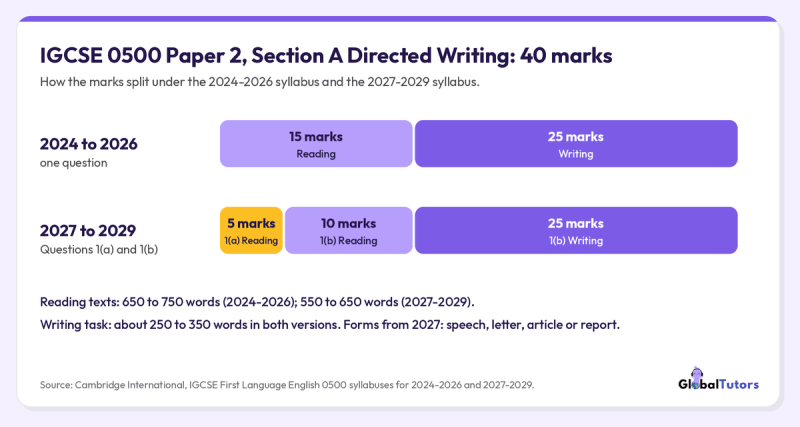 Paper 2's total marks and its 2 hours are unchanged. The 2027 syllabus also lists a report among the forms for 1(b), and the wording of writing objective W4 is now "use language appropriate to purpose and to engage the audience" (in 2024 to 2026 it read "use register appropriate to context").
What the writing objectives ask for
The 25 writing marks in 1(b) are assessed against five objectives:
- W1: articulate experience and express what is thought, felt and imagined
- W2: organise and structure facts, ideas and opinions for deliberate effect
- W3: use a range of vocabulary and sentence structures appropriate to context
- W4: use language appropriate to purpose and to engage the audience
- W5: make accurate use of spelling, punctuation and grammar
The 10 reading marks in 1(b) test whether you understand the explicit and implicit meanings in the texts (R1 and R2), analyse, evaluate and develop the ideas (R3), and select and use information for the task (R5). So build your answer from the texts and evaluate their ideas, as well as writing well for the audience.
How to approach the task
- Read the question before the texts. Note the form (speech, letter, article or report), the audience and the purpose: discursive, argumentative or persuasive.
- Answer 1(a) on what the text does. It assesses R3 and R4, so look at how the writer builds an argument and how they try to influence the reader, as well as what they say.
- Plan 1(b) from the texts. List the ideas you will use, then decide which you agree with, which you will challenge, and why. "Use, develop and evaluate" means more than repeating points.
- Write for the reader you were given. Match the opening, tone and ending to the form and audience.
- Keep to the guide length. The syllabus asks for about 250 to 350 words in 1(b). Plan to stop with time left to check spelling, punctuation and grammar, which W5 assesses.
- Split your time. Both sections carry 40 marks in a 2-hour paper, so plan roughly an hour for each and keep to it.
How to practise
Use the 2027 specimen Paper 2 and its mark scheme, which Cambridge publishes on the 0500 past papers page. Older Paper 2 past papers still help with reading texts and writing for an audience, but their Section A is a single question with a different mark split, so practise 1(a) from the specimen material.
Our 0500 past papers guide explains where to find official papers and examiner reports, and our Cambridge hub covers the curriculum for South African families. For essay structure in general, see how to write a high-scoring English essay.
FAQ
Is directed writing in Paper 1 or Paper 2?
Paper 2, Directed Writing and Composition. It is Section A, worth 40 of the paper's 80 marks.
How many words should directed writing be?
About 250 to 350 words for Question 1(b), under both the 2024 to 2026 and the 2027 to 2029 syllabuses.
Which forms can the directed writing task ask for?
From 2027, a discursive, argumentative or persuasive speech, letter, article or report. The 2024 to 2026 syllabus lists a speech, letter or article.
When do the changes start?
With exams in 2027. The November 2026 series uses the 2024 to 2026 syllabus.
Can I use a dictionary in Paper 2?
No. The syllabus states that dictionaries may not be used.
Get help with IGCSE English
Global Tutors works with South African families at home and abroad. Of our 124 tutors, 16 have examiner, marker or moderator experience, and 51% hold a teaching qualification. Ask for a tutor with examiner, marker or moderator experience. We match you with a tutor within a day, starting with a free Meet & Greet, and there are no ongoing contracts.
Find an IGCSE English tutor | IGCSE essay writing | All IGCSE tutoring
Sources
- Cambridge International, IGCSE First Language English 0500 syllabus page: https://www.cambridgeinternational.org/programmes-and-qualifications/cambridge-igcse-english-first-language-0500/
- Cambridge International, 0500 past papers, examiner reports and specimen papers (2027 specimen Paper 2 and mark scheme): https://www.cambridgeinternational.org/programmes-and-qualifications/cambridge-igcse-english-first-language-0500/past-papers/
- Cambridge International, 0500 syllabus for 2027, 2028 and 2029: https://www.cambridgeinternational.org/Images/718783-2027-2029-syllabus.pdf
- Cambridge International, 0500 syllabus for 2024, 2025 and 2026: https://www.cambridgeinternational.org/Images/635230-2024-2026-syllabus.pdf
Related Cambridge tutoring
Find 1-to-1 tutoring for Cambridge IGCSE and A Level.
Ready to excel in your exams?
Get personalized support from our expert tutors and achieve your academic goals.