IB extended essay timeline: planning the EE step by step
Global TutorsOctober 30, 2026
The IB extended essay (EE) is a 4,000-word research essay that every Diploma Programme student must complete, and the IB expects it to take about 40 hours of the student's own work. The IB sets the external submission date and communicates it to schools. Every earlier date in an EE timeline, from choosing a subject to the final viva voce, is set by the school. This guide sets out what the IB fixes, what it leaves to schools, and how to build a timeline around both. It follows the new extended essay, which the IB launched in February 2025 for first assessment in May 2027.
What the IB fixes and what your school sets
The IB's submission deadline page says the IB sets a submission date for the extended essay, which is communicated to schools. Each school is responsible for making sure that all candidate work, with the required paperwork, reaches the IB by that date. The IB strongly recommends that schools set internal deadlines for the different stages of producing an extended essay, keeping the IB's date in mind, and it directs anyone who wants to know a particular school's deadline to contact that school.
So the dates that shape a student's EE timeline are the school's internal deadlines. Ask the extended essay or Diploma Programme coordinator for the full list of internal dates at the start, and put every one of them in your calendar.
The numbers to plan around
The IB's Extended essay guide (first assessment 2027) and subject brief give these fixed points:
- Length: no more than 4,000 words, covering the introduction, body, conclusion and any quotations.
- Reflective statement: no more than 500 words, written at the end of the process and included on the Reflection and progress form (RPF). The form also records attendance at each reflection session.
- Student time: the essay is the result of approximately 40 hours of work by the student.
- Supervision: a supervision process recommended to be three to five hours long, which includes three mandatory reflection sessions.
- The viva voce: the third and final reflection session is the viva voce, a short interview of 10 to 15 minutes with the supervisor, after the essay is completed. It checks academic integrity and reflects on successes, difficulties and learning.
- The diploma condition: a student must achieve a D grade or higher for the extended essay to be awarded the diploma.
- Points: in combination with the theory of knowledge (TOK) grade, the EE contributes up to three points to the diploma total.
The essay is marked against five criteria. The chart below shows the marks for each, from the IB's extended essay updates page.
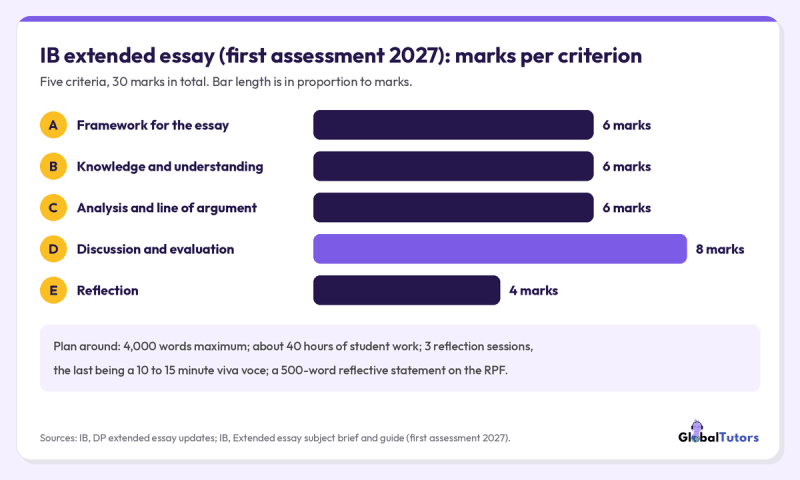
The five criteria add up to 30 marks, and discussion and evaluation carries the most, at 8. The guide says students should have access to the assessment criteria from the beginning of the process, so read them before choosing a topic.
Building your IB extended essay timeline
The IB subject brief lists the steps of the research process and notes that the order may unfold differently for different students. Use those steps as the stages of your timeline, and give each one a date from your school's internal deadlines.
- Choose a broad topic, then refine and focus it.
- Decide the pathway: subject-focused or interdisciplinary (two DP subjects).
- Choose the approved DP subject or subjects. The guide says students must consult the list of available DP subjects for the examination session in question.
- Do some preparatory reading.
- Form a well-focused research question.
- Plan the research and writing process.
- Plan a structure for the essay. The brief notes this may change as the research develops.
- Carry out the research.
After the research come the writing, the final essay with its title page, contents page, introduction, body, conclusion, and references and bibliography, then the viva voce and the reflective statement.
Two pieces of planning advice follow from the IB's numbers. First, turn the 40 hours into weekly blocks. For example, spreading 40 hours evenly over 20 weeks means 2 hours a week; over 16 weeks it means 2.5 hours a week. Count back from your school's final internal deadline to find your number of weeks. Second, leave room after the essay is finished for the viva voce and the 500-word reflective statement, because both come at the end of the process.
Keeping a record as you go
The guide describes the researcher's reflection space (RRS) as a place to record "thoughts, ideas, progress, timelines and arguments", and lists maintaining an RRS as a planning and progress tool. It also lists "establishing a schedule of achievable deadlines" among the ways the EE develops self-management skills.
Use the RRS to keep your timeline in one place:
- Write down each internal deadline as soon as the school gives it to you.
- Before each reflection session, note what you've done, what has changed and what you'll do next.
- Keep a running list of sources with full references, so the bibliography isn't left to the final week.
The reflection sessions are your formal check-ins. The subject brief says they give students the chance to reflect on their engagement with the research process, consider the effectiveness of their choices, and re-examine their ideas and decide whether changes are needed. Arrive at each one with notes from your RRS.
What changed in the new extended essay
The IB's updates page lists these changes for the extended essay assessed from May 2027:
- Two clearly defined research pathways, interdisciplinary or subject-focused. The world studies extended essay has been absorbed into the interdisciplinary pathway.
- Categories have been removed from language A and language B essays.
- Reflection now focuses more on the student's growth through the EE experience, notably the transferable skills learned.
- Redesigned assessment criteria, covering the same areas as before.
Students assessed before May 2027 follow the previous extended essay.
For an overview of the EE itself, read our IB Extended Essay guide. The EE and TOK together give up to three points, and our IB TOK guide covers TOK. For the whole programme, see the IB Diploma Programme guide, and for university entry at home, IB in South Africa.
FAQ
How long should the IB extended essay take?
The IB says the essay is the result of approximately 40 hours of work by the student.
When is the IB extended essay deadline?
The IB sets a submission date and communicates it to schools. Each school sets its own internal deadlines before that date, and the IB says to contact the school for its deadline.
How many reflection sessions are there?
Three mandatory reflection sessions with the supervisor. The third is the viva voce, a 10 to 15 minute interview after the essay is completed.
How long is the reflective statement?
No more than 500 words. It is written at the end of the process and included on the Reflection and progress form (RPF).
What grade do you need on the extended essay?
A D grade or higher, to be awarded the diploma.
Get help planning the extended essay
Global Tutors works with South African families at home and abroad, including IB Diploma students. Of our 124 tutors, 16 have examiner, marker or moderator experience, and 51% hold a teaching qualification. Ask for a tutor with examiner, marker or moderator experience. We match you with a tutor within a day, starting with a free Meet & Greet, and there are no ongoing contracts.
Find an IB Diploma tutor | IB tutoring hub
Sources
- IB, Extended essay: https://www.ibo.org/programmes/diploma-programme/curriculum/dp-core/extended-essay/
- IB, Extended essay submission deadline: https://www.ibo.org/programmes/diploma-programme/curriculum/dp-core/extended-essay/submission-deadline/
- IB, Extended essay subject brief (first assessment 2027): https://ibo.org/globalassets/new-structure/university-admission/pdfs/ee_subjectbrief_en.pdf
- IB, Extended essay guide (first assessment 2027): https://ibo.org/globalassets/new-structure/university-admission/pdfs/subject-guides/extended-essay-first-assessment-2027-guide-sbs.pdf
- IB, DP extended essay updates: https://www.ibo.org/university-admission/latest-curriculum-updates/dp-extended-essay-updates/
Ready to excel in your exams?
Get personalized support from our expert tutors and achieve your academic goals.