
What an IEB moderator does, and why it matters for your child
Global TutorsOctober 19, 2026
An IEB moderator is an experienced subject expert who checks other people's assessment work. For the final matric exams, the internal moderator checks each question paper and its marking guideline against the rules, and during marking makes sure markers apply the guideline correctly. At school level, IEB moderators check the school-based assessment (SBA) that counts for 25% of the final mark in most subjects. For your child, moderation is one of the checks on how their marks are set and awarded.
Who checks an IEB paper before your child writes it
Every final IEB question paper goes through several hands. Umalusi, the quality council for school exams, describes the system in its report on the IEB's November 2025 exams:
- The examiner sets the question paper and marking guideline. Each subject has one examiner and one internal moderator. For subjects with two papers, the IEB appoints an examiner for each paper and one internal moderator for both.
- The internal moderator makes sure each question paper "adheres fully to the prescripts of the policy and the subject assessment guidelines".
- Umalusi moderates the question papers externally. After that moderation, Umalusi reported that all of the IEB's November 2025 question papers complied with the subject assessment guidelines.
The moderator is senior to the examiner. According to Umalusi, the IEB requires an internal moderator to have been an examiner, and an examiner to have been a senior marker in the IEB system.
In plain terms, the moderator asks: is this paper fair, is it at the right level, does it test what the subject guidelines require, and will the marking guideline work for real answers?
What happens after the exam
Marking guideline meetings. Before marking starts, the marking guideline for each paper is finalised at a standardisation meeting. For November 2025, Umalusi reported that in the subjects it sampled, chief examiners and internal moderators marked between two and six sample ("dummy") scripts beforehand, so real learner answers shaped the final guideline. The meetings also agree on alternative correct responses.
Training markers. Umalusi reported that markers could only start live marking after the chief marker or internal moderator had confirmed that their marking met the required standard.
Verification. Umalusi then verifies a sample of the marking against the approved guidelines, and standardises the results. In November 2025 it accepted the raw marks for 47 of the IEB's 58 NSC subjects, adjusted 7 mainly upwards and adjusted 4 downwards.
Moderation of school-based assessment
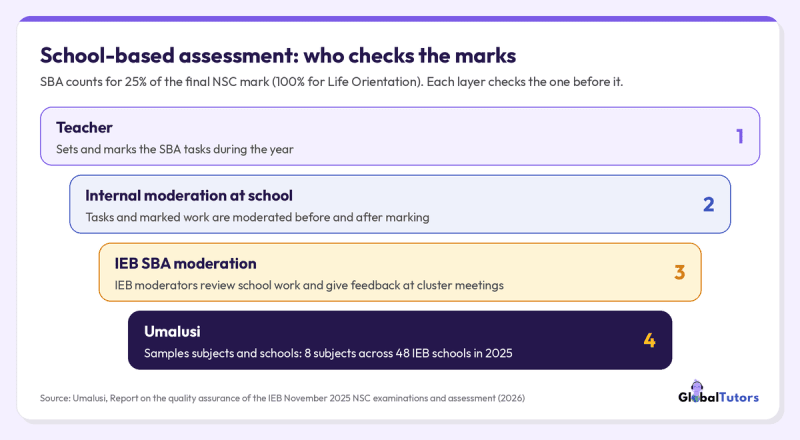
SBA is the formal tests, tasks, projects and exams your child writes at school during the year, including the prelims. Umalusi confirms that SBA counts for 25% of the final mark (100% for Life Orientation) and must be moderated by both the IEB and Umalusi. Because the school sets and marks these tasks, they're checked in layers:
- The teacher sets and marks each task.
- The school moderates the tasks and marked work internally.
- The IEB appoints SBA moderators. Its FAQ lists "examiners, internal moderators, PAT developers, and SBA moderators" among the posts it advertises to schools. Umalusi reports that IEB moderators run cluster workshops and that moderation reports are discussed with schools at cluster meetings held twice a year.
- Umalusi samples subjects and schools. For November 2025 it moderated SBA in eight subjects across 48 IEB schools, and also moderated practical assessment tasks and orals.
Umalusi's reports also record problems. In 2025, for example, one school's Mathematics prelim left out Finance and Probability, and four of six History schools sampled reused old question papers word for word.
Why the IEB moderator matters for your child
It protects fairness. Every marker works from the same finalised guideline and is checked before marking live scripts.
It explains why school and final marks can differ. School tasks are set by each school. The final papers go through internal moderation, Umalusi's moderation and standardisation. A gap between the two isn't necessarily a mistake.
It changes how to prepare. Final papers are checked against the subject assessment guidelines, so practise on official IEB papers, not only on routine class questions. The IEB offers papers and marking guidelines from the previous five years, and our IEB past papers guide explains how to use them.
It tells you what to look for in a tutor. To mark for the IEB, a teacher must teach the subject in Grade 12 at an IEB school and hold a qualification in it. Examiners and moderators also need marking experience. If that experience matters to you, ask for a tutor who has examined, marked or moderated.
What parents can do with this
- Know the options after results. The IEB offers a re-mark (the whole paper is marked again) or a re-check (the IEB checks that every question was marked and the marks were counted and captured correctly). Applications open for a limited period after results are released.
- Know how a re-mark works. According to the IEB, a re-mark can raise, lower or keep a mark, but the IEB only changes the result if the mark goes up.
- Viewing a script is possible, with conditions. A learner must first apply for a re-mark or re-check. If they're still not satisfied, they can write to the IEB's CEO to ask to view the script. There is a fee, and only an educationist may view it.
- Read a gap between SBA and exam marks as a signal, not as proof that one set of marks is wrong. It's a reason to practise under exam conditions.
Our matric results guide covers results day, and our IEB vs DBE (CAPS) exams guide compares the two exam systems.
FAQ
What's the difference between an IEB examiner and a moderator?
The examiner sets the question paper and marking guideline. The internal moderator checks that the paper meets the policy and subject guidelines, and oversees marking standards. The IEB requires moderators to have been examiners first.
Who moderates IEB exams externally?
Umalusi. It moderates the question papers, samples school-based assessment, verifies a sample of the marking and standardises the results.
Does moderation lower my child's marks?
Not by itself. Moderation of marking makes sure the guideline is applied consistently, which can move a mark either way. In November 2025, Umalusi accepted the raw marks in 47 of 58 subjects.
Who can become an IEB marker?
A Grade 12 teacher at an IEB-registered school who teaches the subject at Grade 12 level and has a qualification in it. The IEB advertises marking posts through circulars to schools.
Can I see my child's marked script?
Only after applying for a re-mark or re-check. A letter to the CEO is then needed, there is a fee and only an educationist may view the script.
Learn from tutors who have marked and moderated
Of our 124 tutors, 16 have examiner, marker or moderator experience, two of them with the IEB, and 51% hold a teaching qualification. Ask for a tutor with examiner, marker or moderator experience. We match you with a tutor within a day, starting with a free, no-obligation Meet & Greet. There are no ongoing contracts.
Find an IEB matric tutor | All IEB tutoring | Online tutoring for IEB learners
Sources
- Umalusi, Report on the quality assurance of the IEB November 2025 NSC examinations and assessment: https://www.umalusi.org.za/wp-content/uploads/2026/03/REPORT-ON-THE-QA-OF-THE-IEB-NOVEMBER-2025-EXAMINATIONS-1.pdf
- IEB, FAQ (markers, moderator posts, re-marks, re-checks and viewing scripts): https://www.ieb.co.za/faq
- IEB, NSC past papers and marking guidelines: https://www.ieb.co.za/assessment/high-schools/national-senior-certificate/nsc-past-papers
Related IEB tutoring
IEB and Matric tutoring for South African students.
Ready to excel in your exams?
Get personalized support from our expert tutors and achieve your academic goals.