
NSC Maths Paper 2: the trigonometry and geometry survival guide
Global TutorsOctober 22, 2026
The DBE's NSC Mathematics Paper 2 is a three-hour, 150-mark paper covering statistics, analytical geometry, trigonometry and Euclidean geometry. In 2026 it is written on Monday 26 October at 09:00. Trigonometry and Euclidean geometry together carry 90 of the 150 marks in the DBE's Examination Guidelines, so this guide focuses on those two topics: how the marks are set out, how the DBE's marking guidelines award them, and how to use the last days before the paper.
How matric Maths Paper 2 is set out
The DBE's Mathematics Examination Guidelines for Grade 12 set the weighting of topics in Paper 2:
- Statistics and regression: 20 marks
- Analytical geometry: 40 marks
- Trigonometry: 50 marks
- Euclidean geometry: 40 marks
- Total: 150 marks in 3 hours
That works out to 1.2 minutes per mark. A 10-mark question deserves about 12 minutes, and a 23-mark question about 28 minutes.
The November 2025 paper followed this pattern. It had 11 questions. The cover page gave 150 marks and 3 hours, and the paper came with an information sheet of formulae and a separate answer book. Its instructions included:
- Answer ALL the questions in the SPECIAL ANSWER BOOK provided.
- Clearly show ALL calculations, diagrams, graphs, etc. which you have used in determining your answers.
- Answers only will NOT necessarily be awarded full marks.
- You may use an approved scientific calculator (non-programmable and non-graphical), unless stated otherwise.
- If necessary, round off answers to TWO decimal places, unless stated otherwise.
- Diagrams are NOT necessarily drawn to scale.
Before Question 9, the paper said: "Provide reasons for your statements in QUESTIONS 9, 10 and 11." Those three geometry questions carried 41 of the 150 marks.
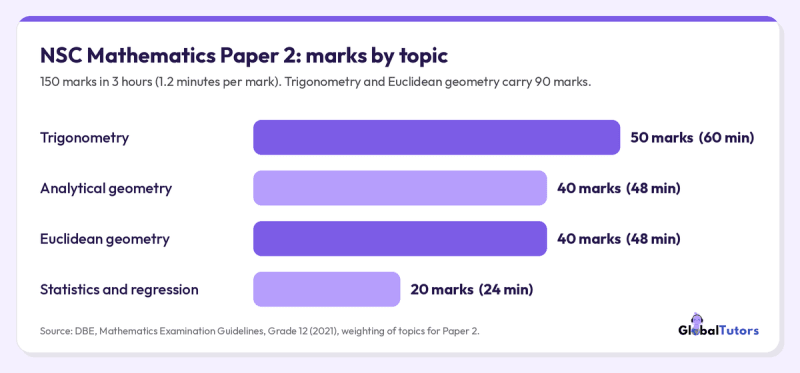
The chart above shows the topic weighting from the Examination Guidelines. Trigonometry is the largest single topic.
What the trigonometry section covers
CAPS lists the Grade 12 trigonometry content, and the Examination Guidelines add detail on how it is examined. The parts to revise are:
- Compound and double angle identities. CAPS lists the compound angle identities for sin(α ± β) and cos(α ± β), sin 2α = 2 sin α cos α, and cos 2α in three forms: cos²α - sin²α, 2cos²α - 1 and 1 - 2sin²α.
- General solutions of trigonometric equations.
- Trigonometric graphs. The Examination Guidelines say the focus is "on the relationships, simplification and determining points of intersection by solving equations".
- Problems in two and three dimensions. The guidelines also say measurement can be tested in two- and three-dimensional trigonometry.
- Reciprocal ratios. Cosec, sec and cot can be used in answers but "will not be explicitly tested".
Worked example 1: an exact value
Find cos 75° without a calculator.
cos 75° = cos(45° + 30°) = cos 45° cos 30° - sin 45° sin 30°
= (√2/2)(√3/2) - (√2/2)(1/2)
= (√6 - √2)/4
Check on a calculator: (√6 - √2)/4 = 0.2588..., and cos 75° = 0.2588....
Worked example 2: an identity
Prove that sin 2x / (1 + cos 2x) = tan x.
LHS = 2 sin x cos x / (1 + 2cos²x - 1)
= 2 sin x cos x / (2cos²x)
= sin x / cos x
= tan x = RHS
Choose the form of cos 2x that cancels the 1. Here 2cos²x - 1 does that.
Worked example 3: a general solution
Solve sin 2x = cos x.
2 sin x cos x - cos x = 0
cos x (2 sin x - 1) = 0
cos x = 0, so x = 90° + k × 180°
or sin x = 1/2, so x = 30° + k × 360° or x = 150° + k × 360°, where k is an integer.
Between 0° and 360° that gives 30°, 90°, 150° and 270°. Divide by cos x and you lose the cos x = 0 solutions, so factorise instead.
How Euclidean geometry is marked
The November 2025 marking guidelines explain the geometry marks with three codes:
- S: "A mark for a correct statement (A statement mark is independent of a reason)"
- R: "A mark for the correct reason (A reason mark may only be awarded if the statement is correct)"
- S/R: "Award a mark if statement AND reason are both correct"
Write every statement with its reason next to it. A correct reason can only earn its mark next to a correct statement.
The Examination Guidelines include a list of acceptable reasons, the shortened theorem statements the DBE encourages "in order to have some kind of uniformity". Examples include "ext ∠ of Δ", "∠s opp equal sides", "opp ∠s of cyclic quad", "tan chord theorem" and "line || one side of Δ" (or "prop theorem; name || lines"). Learn the list in that wording.
The guidelines name seven theorems whose proofs are examinable:
- The line from the centre of a circle perpendicular to a chord bisects the chord.
- The line from the centre of a circle that bisects a chord is perpendicular to the chord.
- The angle an arc subtends at the centre is double the angle it subtends at the circle.
- The opposite angles of a cyclic quadrilateral are supplementary.
- The tan chord theorem: the angle between a tangent and a chord equals the angle in the alternate segment.
- A line parallel to one side of a triangle divides the other two sides proportionally.
- Equiangular triangles are similar.
Practise writing out each proof in full, with the construction where one is needed. In the 2025 memo, Question 9.1 (the centre-angle theorem) started with a construction mark.
Worked example 4: proportionality
In triangle ABC, D lies on AB and E lies on AC, with DE || BC. AD = 6 cm, DB = 4 cm and AE = 9 cm. Find EC.
AD/DB = AE/EC [line || one side of Δ; DE || BC]
6/4 = 9/EC
EC = 9 × 4 ÷ 6 = 6 cm
How the marking guidelines treat working
The general notes at the start of the 2025 Paper 2 marking guidelines say:
- "If a candidate answers a question TWICE, only mark the FIRST attempt."
- "If a candidate has crossed out an attempt of a question and not redone the question, mark the crossed-out version."
- "Consistent accuracy applies in ALL aspects of the Marking Guidelines. Stop marking at the second calculation error."
- "Assuming answers/values in order to solve a problem is NOT acceptable."
So cross out an attempt you don't want marked, and don't leave two versions of the same answer. Show each step, because a later mark can still follow from an earlier error. Don't plug in a value you're trying to prove.
A plan for the final days
- Rank the topics by marks. Trigonometry (50) is the biggest block, then analytical geometry and Euclidean geometry (40 each). Give your revision time in roughly that order.
- Write one past paper under exam conditions. Use the November 2025 paper and its marking guidelines from the DBE website, and time it at 1.2 minutes per mark.
- Mark it with the official guidelines. Check where your statement marks and reason marks went.
- Rewrite the seven proofs from memory. Then check them against your textbook.
- Check your calculator setting. Use degrees, and round to two decimal places unless the question says otherwise.
Our CAPS hub explains the curriculum, and the matric exam timetable lists the 2026 dates. After the exams, our matric results guide covers results day.
FAQ
When is NSC Maths Paper 2 in 2026?
Monday 26 October 2026, from 09:00, for three hours. Mathematics Paper 1 is on Friday 23 October.
How many marks is trigonometry worth in Paper 2?
50 of the 150 marks, in the DBE's Examination Guidelines. Euclidean geometry carries 40.
Do I need reasons in Euclidean geometry?
Yes. The 2025 paper said to provide reasons for statements in Questions 9, 10 and 11, and reason marks are only awarded when the statement is correct.
Are formulae given?
Yes. The November 2025 information sheet included the sine, cosine and area rules and the compound and double angle identities. Practise choosing the right one for each question.
What calculator is allowed?
An approved scientific calculator, non-programmable and non-graphical, unless the paper says otherwise.
Get help before Paper 2
South African families at home and abroad use Global Tutors for matric Maths. Of our 124 tutors, 16 have examiner, marker or moderator experience, and 51% hold a teaching qualification. Ask for a tutor with examiner, marker or moderator experience. We match you with a tutor within a day, starting with a free, no-obligation Meet & Greet, and there are no ongoing contracts.
Find a CAPS Maths tutor | Matric tutoring | All CAPS tutoring
Sources
- DBE, October/November 2026 NSC examinations timetable: https://www.education.gov.za/Portals/0/Documents/Publications/2026/2026 Nov NSC Timetable.pdf
- DBE, Mathematics Examination Guidelines, Grade 12 (2021): https://www.education.gov.za/Portals/0/CD/2021 Exam Guidelines/Mathematics GR 12 Exam Guidelines 2021 Eng.pdf?ver=2021-05-17-160015-740
- DBE, 2025 November NSC exam papers (Mathematics Paper 2 and marking guidelines): https://www.education.gov.za/Curriculum/NationalSeniorCertificate(NSC)Examinations/2025NovemberExamPapers.aspx
- DBE, CAPS Mathematics FET Phase (Grades 10 to 12): https://www.thutong.doe.gov.za/ResourceDownload.aspx?id=44785
Ready to excel in your exams?
Get personalized support from our expert tutors and achieve your academic goals.